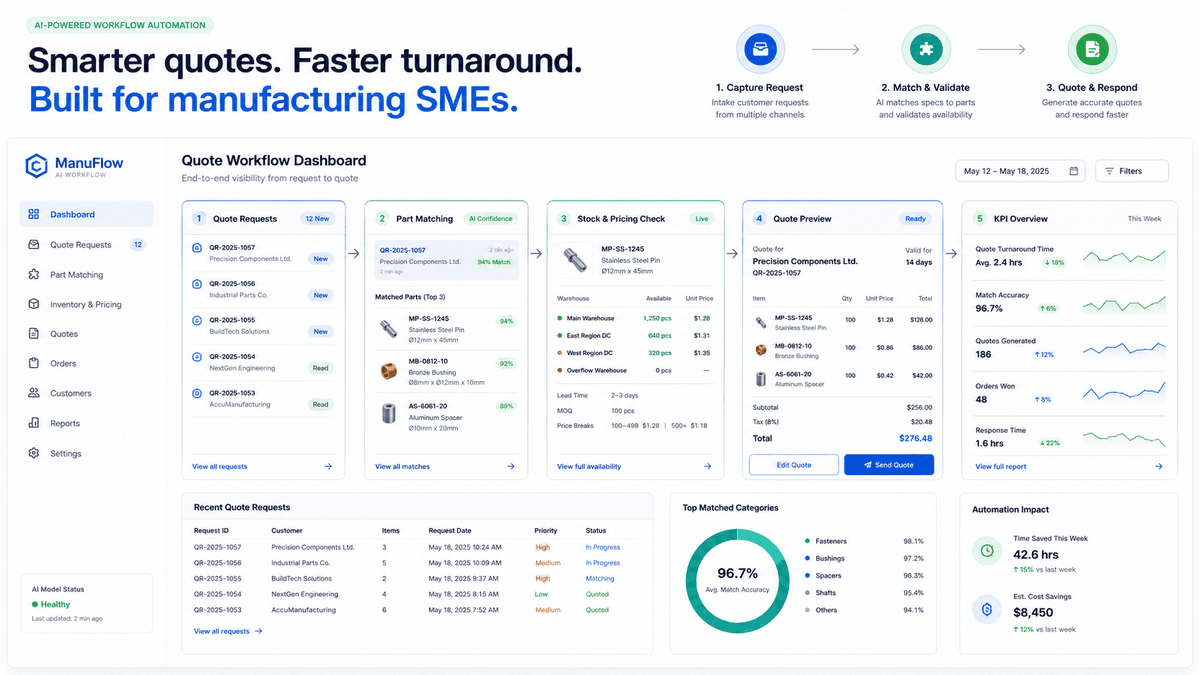
Manufacturing operations dashboard showing AI-assisted quote workflow automation

AI Workflow Automation for UK Manufacturers

The useful opportunities are often less glamorous than an autonomous factory: catch the exception earlier, prepare the paperwork, and stop keying the same data twice.

UK manufacturing SMEs run on tight margins. The biggest AI wins aren't moonshot autonomous-factory projects — they're prosaic: catch the defect on the line, predict the bearing failure, get the invoice processed without three people touching it.

The strongest starting point is a process with enough volume to matter and clear rules for what should happen next. That gives the team something concrete to test before a wider rollout.

Common Operational Pain Points

Where manufacturing teams lose time

Invoice and PO processing eats days every month

Finance staff manually match invoices against purchase orders and goods receipts across ERP, email, and spreadsheets. Errors cause payment disputes and slow down month-end close.

Quality defects caught too late

Visual inspection relies on fatigued operators catching defects at the end of the line. Missed defects reach customers, trigger returns, and damage relationships.

Unplanned downtime from reactive maintenance

Machines fail without warning because sensor data sits in silos. Maintenance is reactive, expensive, and kills production schedules.

Shop-floor reporting is incomplete or late

Operators skip incident and downtime reports because the forms are slow. Management decisions rely on stale, patchy data.

How It Works

What the Workflow Could Look Like

These examples show the sequence of work, not a fixed product. The real version would follow your systems, rules, and exceptions.

Three-Way Invoice Matching

Trigger: Supplier invoice arrives by email or upload

  1. 1AI extracts line items, totals, and references from the invoice
  2. 2Matches against purchase order and goods received note in ERP
  3. 3Cross-references pricing, quantities, and delivery terms
  4. 4Flags discrepancies and routes exceptions for human review
  5. 5Posts clean entries with full audit trail
What changes

Finance reviewers focus on exceptions rather than re-keying

Vision Quality Inspection

Trigger: Product passes camera checkpoint on the line

  1. 1Edge device captures image at production speed
  2. 2Vision model checks for surface defects, label errors, fill levels
  3. 3Confident passes continue; flagged items divert for human QC
  4. 4Defect data logs to MES with type, location, and timestamp
What changes

Potential defects are flagged before release

Predictive Maintenance Alerts

Trigger: Sensor readings collected continuously from PLCs

  1. 1Vibration, temperature, and current data ingested from existing sensors
  2. 2ML model detects anomaly patterns 1–4 weeks before failure
  3. 3Alert sent to maintenance team with asset, predicted failure mode, and urgency
  4. 4Maintenance scheduled during planned downtime window
What changes

Maintenance moves from reactive to planned

Manufacturing

Five Workflows Worth Examining

Use these as a shortlist, not a shopping catalogue. The right first project depends on where your team loses time and how often the process repeats.

1

Invoice & purchase-order automation with three-way match

Read supplier invoices, match against the PO and the goods-receipt, and post clean entries into your accounting system. Exceptions go to a human; everything else flows through untouched.

Read the case study
2

Production quality-control vision inspection

A vision model runs on a small edge device beside the line, flagging defects (mis-fills, label errors, surface flaws) before they leave the factory. Trains on a few hundred labelled examples.

3

Predictive maintenance from sensor data

Ingest vibration, temperature, and current data from existing PLCs / sensors. ML model surfaces failure-mode anomalies 1–4 weeks ahead so maintenance moves from reactive to planned.

4

ISO / QMS / audit Q&A bot

Quality manager and shop-floor leads chat with an assistant grounded in your QMS, work instructions, and current ISO standards. Answers cite the source document and section.

5

Plain-language shop-floor incident reporting

Operators describe an issue (downtime, scrap, near-miss) in plain English on a tablet. AI structures it into the right MES / EHS fields and routes it to the right manager.

Manufacturing — frequently asked questions

We don't have a clean data pipeline — can we still do predictive maintenance?+
Yes. We deploy lightweight collectors that read existing PLC and sensor outputs without modifying your control system. Data quality is part of the pilot, not a prerequisite for it.
Will an edge vision system slow down our line?+
No. Vision inspection runs in parallel on a separate device, with sub-100ms inference. The line is unaffected if the inspection device fails — defects just fall through to the existing QC checkpoint.
Do you have manufacturing references?+
Yes. Our invoice-automation case study (link in the section above) is a UK manufacturing SME. We can introduce you to the operations director once we're under NDA.
What's a typical first-project budget?+
A scoped 4–6 week pilot on one use case, fixed-price. We only progress to a full rollout once the pilot has hit a pre-agreed ROI threshold on your real data.

How We Work

From a Frustrating Process to a Working Workflow

We map what really happens, build a small version, and let your team try it on real work before anyone commits to a larger rollout.

  1. 01

    Workflow Review

    We map the manual process end-to-end: systems involved, current time cost, error points, and business impact.

    60–90 minutes
    Workflow map and automation opportunity summary
  2. 02

    Bottleneck Prioritisation

    We select the workflow with the strongest mix of pain, feasibility, and measurable ROI — so you start where it matters most.

    2–3 working days
    Prioritised workflow and success criteria
  3. 03

    Prototype Build

    We build a small AI-assisted workflow using your sample data, screenshots, exports, or existing documents. No dummy demos.

    10–14 working days
    Working prototype or interactive demo
  4. 04

    Human Review and Controls

    We add review points, exception handling, confidence thresholds, and fallback rules — so nothing runs unsupervised until you trust it.

    Included in prototype
    Controlled workflow ready for pilot
  5. 05

    Pilot and Measurement

    We test the workflow with real users and measure time saved, errors reduced, and adoption issues before scaling anything.

    2–4 weeks
    Pilot report and scale recommendation
  6. 06

    Deploy or Improve

    We scale the workflow and integrate it properly — or stop if the numbers do not justify further spend. No lock-in.

    Based on pilot results
    Deployment plan or improvement backlog

Practical and Proven

A structured approach focused on real business outcomes.

Human-Centred by Design

Automation with the right controls, transparency, and accountability.

Continuous Value

Measure, learn, and improve — so your operations keep getting better.

Free Manufacturing Workflow Audit

30 minutes. We review your top operational bottleneck, estimate the time and cost savings from automation, and tell you honestly whether it is worth pursuing.

Request Your Free Audit